The digital asset market closed last week under meaningful pressure, with Bitcoin posting a decline of approximately 14% and briefly touching lows near $59,000, its weakest print since October 2024. The move lower was not driven by a single catalyst but rather a confluence of factors that reinforced one another: escalating geopolitical tensions between Israel and Iran, a stronger-than-expected U.S. employment report for May, and a sharp repricing of interest rate expectations. As of Monday morning, Bitcoin trades around $62,496, having staged a partial recovery over the weekend. The bounce is encouraging, though the broader picture calls for measured optimism rather than outright enthusiasm.
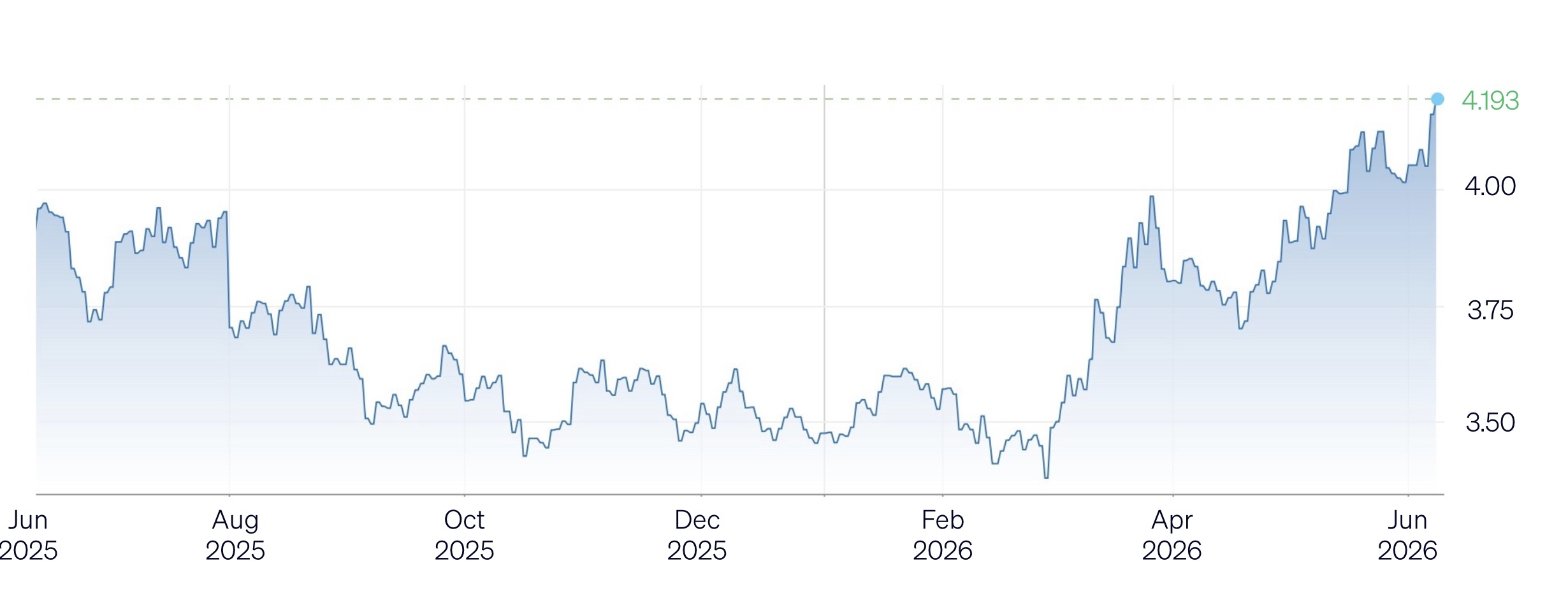
On the macroeconomic front, the two-year U.S. Treasury yield climbed to 4.19% on Monday, its highest level since February 2025, as markets reassessed the Federal Reserve's policy path following the blowout May jobs report. What makes this shift particularly notable is how much it diverges from consensus expectations at the start of the year, when at least two rate cuts were priced in for 2026. Markets are now fully pricing a quarter-point rate hike by year-end. Rising yields tend to weigh on risk assets broadly, and digital assets are no exception. President Trump pushed back against this narrative over the weekend, calling rate hikes "the wrong thing to do" and reiterating his preference for lower borrowing costs. Whether that sentiment finds any traction at the June 16 to 17 FOMC meeting remains to be seen.
Geopolitical risk added another layer of complexity. Iran and Israel exchanged direct military strikes over the weekend, renewing hostilities that had paused under an April ceasefire. Oil prices jumped more than 3%, Asian equity indexes fell sharply, and risk assets pulled back broadly in early Monday trading. Trump urged restraint from both sides, noting proximity to a potential diplomatic deal, but the escalation nonetheless rattled sentiment at a moment when markets were already fragile. This geopolitical backdrop is unlikely to resolve quickly and will continue to serve as a source of elevated volatility in the weeks ahead.
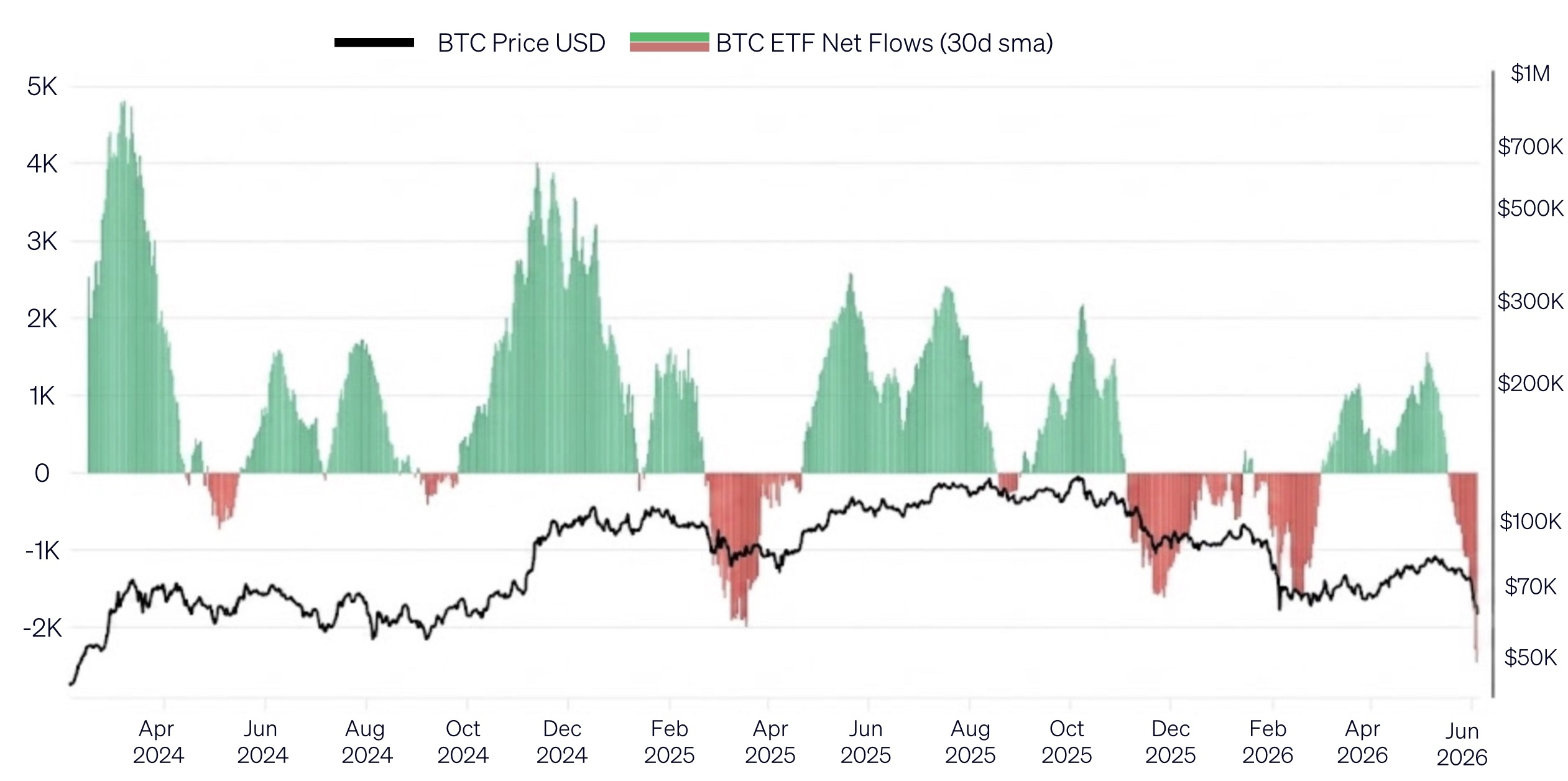
Within the digital asset ecosystem, the behavior of spot Bitcoin ETFs has attracted considerable attention. Last week alone saw net outflows of $1.72 billion, the largest single-week redemption in over a year. What distinguishes the current episode from the February selloff, when Bitcoin also tested the $60,000 zone, is the direction of institutional behavior. In February, outflows slowed as prices dropped, with buyers absorbing weakness. This time, outflows have accelerated for four consecutive weeks alongside falling prices, pointing to a more cautious institutional stance. That said, the ETF structure remains a landmark achievement for the asset class, having brought Bitcoin into the portfolios of advisors, family offices, and institutional allocators who previously lacked an accessible vehicle. The infrastructure is there; the question now is about the macro and sentiment conditions needed to attract flows back in.
Strategy, the firm formerly known as MicroStrategy and now the world's most prominent corporate Bitcoin holder with 843,706 BTC on its balance sheet, found itself at the center of debate last week. The company disclosed that it had sold 32 BTC, worth approximately $2.5 million, its first sale since 2022. While immaterial in the context of its treasury, the transaction drew scrutiny given that Strategy has long been viewed as one of Bitcoin's most consistent demand anchors. Concerns around dividend obligations surfaced, amplified by SEC filings showing plans by the CEO and CFO to sell a combined $15 million in MSTR shares. In response, Executive Chairman Michael Saylor posted his signature Bitcoin acquisition tracker chart on Sunday with the caption "A good time to add more dots," a move traders widely interpreted as a signal that a new purchase disclosure is imminent. CEO Phong Le reinforced the message publicly, describing the firm's mandate as increasing net Bitcoin and Bitcoin per share over time.
The weekend also brought a partial recovery across major digital assets. Bitcoin rose approximately 3% to near $63,000, while Ethereum gained around 6.5% to the $1,687 area and Solana added close to 5%, trading near $66. The move is best read as a relief rally following an oversold condition rather than the start of a new directional trend. Bitcoin continuing to hold above $60,000 remains a constructive technical reference, and structural inflows into digital asset investment products remain meaningful even against near-term volatility, with approximately $11 billion attracted over seven weeks through early June.
Looking Ahead:
The week ahead carries several catalysts worth monitoring. U.S. inflation data expected mid-week could either reinforce or moderate the rate hike narrative driving recent Treasury yield moves, ahead of the June 16 to 17 FOMC meeting, where new Fed Chair Kevin Warsh will chair his first policy decision. On the geopolitical side, Israel-Iran dynamics remain fluid, and any de-escalation signal could serve as a meaningful relief catalyst for risk assets broadly.
Within crypto specifically, all eyes will be on whether Strategy follows through on Saylor's Sunday post, where he shared his signature Bitcoin acquisition tracker chart captioned "A good time to add more dots." Any confirmed purchase announcement would likely provide a meaningful positive sentiment jolt to the market. ETF flow data will also be closely watched to assess whether the outflow trend begins to stabilize. Bitcoin's ability to hold the $60,000 to $62,000 range will be the key technical reference for market participants. A consolidation above that zone through the week could set up a more constructive setup heading into the FOMC decision. The market is navigating a genuinely complex environment, but the institutional infrastructure built over the past two years provides a meaningful foundation from which a recovery can be staged once conditions stabilize.
Between Warsh and Hormuz: Digital Assets Steady as Risks Converge
Bitcoin tests $60K amid rising yields, Israel-Iran tensions, ETF outflows, and Fed uncertainty. Can institutional demand support a recovery?